

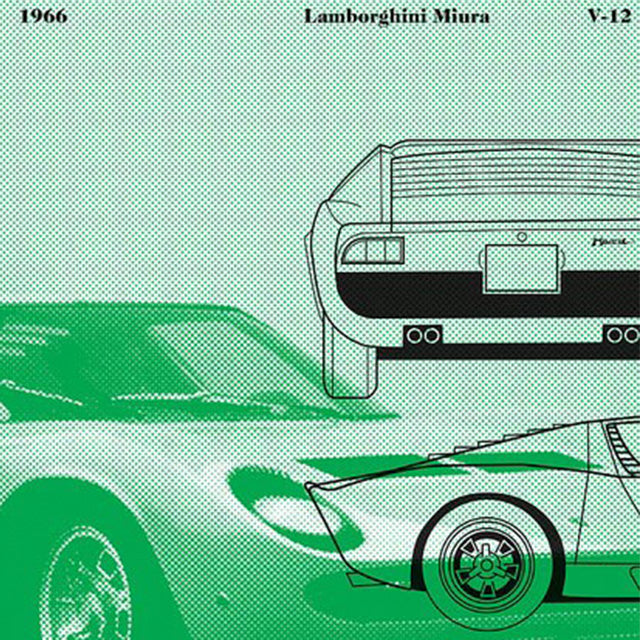
There’s no denying that the mid-1960s and mid-1970s was a rich, creative period for car design in Italy. The level of unrestrained freedom was simply astounding. While the Countach heralded the arrival of a new more aggressive, angular and razor-like design aesthetic for Lamborghini and the Miura was a more traditional, feminine and sensuous proposition; there are few automotive creations as exquisite.
Developed before the game-changing Countach and iconic Stratos, the beautifully-clean, elegant Miura was a pivotal car for Bertone, more so than any other before it. It was the car that forged a relationship between Lamborghini and Bertone that lasted until Chrysler bought the Sant’Agata-based supercar maker in 1987.
As the story goes: Ferruccio Lamborghini invited Giuseppe ‘Nuccio’ Bertone to his factory following the unveiling of a rolling box-frame chassis his engineers had created and shown at the 1965 Turin motor show. The platform was fitted with a transverse 12-cylinder powerplant mounted mid-ship. It was revolutionary.
“Lamborghini was a pioneer,” recalls current Bertone design director Michael Robinson. “The Ford GT-40 came out in 1964, the year before the P400 chassis was shown at the Turin motor show, but it was a race car, not a production car. Lamborghini was the first person to put a 12-cylinder transversal mid-engined car into production.”


Pleased at what he’d seen emerge from Bertone’s studio in the decade leading up to the P400 platform unveiling, Lamborghini asked Bertone to cloak the chassis, which would be designed at Bertone’s Stile division led by then 27-year-old Marcello Gandini.
True to the old ‘form follows function’ adage, Gandini had to work tirelessly to get the bodywork to fit the innovative platform. Under the guidance of Nuccio Bertone, he successfully completed the project just in time for its unveiling.
“Gandini did this car in two months when he first arrived here, which is hard to believe,” Robinson says. “They did the concept car, had a running prototype, and Nuccio Bertone drove the car from Caprie up to Geneva the night before the show opened.”
Even the delivery method was a world away from the sheltered existence of modern concept cars. Most companies push their concepts into covered transporters and ship them to the shows where they’re displayed. And if they run, nobody would dream of driving them through snowy passes in the dead of winter…
But that wasn’t the case with Nuccio, who was known to pilot his creations through snowstorms.
“Lily Bertone talks about the fact that they had a house in the Alps and used to go skiing all the time,” Robinson recounts. “Though she’d wanted to take a different car, Nuccio insisted on taking the Miura and drove it straight into a snow bank! They had to wait for someone to come along and pull them out.”
It’s no secret that the Miura wasn’t famous for its handling. It was conceived first and foremost for straight-line performance.
“Lamborghini came through the engine world,” says Robinson. “He didn’t have the race track record that Enzo Ferrari did. Ferrari started racing with Alfa Romeo and was a race-bred manufacturer.
“Lamborghini made tractors. He wasn’t as adept with the suspensions and brakes and balance that go into racecars. He was more about big engines and beautiful sexy lines. That was more than enough to get world acclaim.”


The Miura coined the term ‘supercar’ when it graced the Geneva motor show floor in 1966. At nearly 14½ feet long, the car was just 3½ feet tall and beautifully proportioned. Its 4.0-liter V12 produced 350bhp and propelled the 2370-lb machine to 62mph in 5.5 seconds. That’s scintillating performance even by today’s standards.
Though breathtaking, the Miura’s design was fairly conventional. The long, flowing hood and cab-rearward architecture – typical of 1960s-era sports cars – was unnecessary in a mid-engined vehicle. Bertone and Gandini would break away from these conventions when designing the cab-forward Alfa Romeo Carabo two years later and the Stratos Zero and Countach models in the ‘70s.
Composed of three main structures, Gandini created two unique clamshells for the front and rear ends of the Miura, which opened in opposite directions. Besides its elegant form, Gandini also devised some spectacular details for the car. Elements like the metal lashes on the headlamps, the vents on the B-pillar that integrated the door handle in the slats and the very soft curve that sweeps from the beltline up to the roof were key visual identifiers, which became trademarks of Gandini’s unusual, out-of-the-box thinking. Everything was very clean and pristine.
“That’s what sets this car apart still today,” says Robinson, “Even though the architecture could be tied to the GT-40, a Ferrari or a Corvette of the era, the details just put it in a world of its own.”
The leather-clad (vinyl in early models) cabin had a gated shifter, roof-mounted switchgear and prominent dials, but it was cramped and ergonomically challenged. The seating position was low and reclined, more akin to flying in a Concorde than driving a car, and the doors themselves were made to resemble a bull’s horns when opened. All of this could only be the product of its creator, Gandini, who’d spent most of his time designing interiors for nightclubs prior to arriving at Bertone.
Over the course of its seven-year production run, several different models were created, including the S and SV as well as the one-off J and ZN-75 roadster. Each production model increased power gradually, from 370bhp in the S and rising to 385bhp for the last model, the SV. In all only 765 Miuras were ever built, going to owners like Frank Sinatra and Twiggy.
Born in simpler times when designers didn’t have to contend with safety legislation and pedestrian impact requirements, the Miura was a car created when style reigned supreme. The product of a very healthy period of development, the Miura was a supremely elegant low-slung sports car so effortlessly beautiful that it has and will forever remain an iconic design, and a momentous car for Bertone.
(Petrolicious is celebrating 100 years of Bertone. Click here to see all of our Bertone posts.)


Article Photo Sources: 1 (Bold Ride), 2, 3, 4, 5, 6, 7 (Silodrome), 8, 9, 10, 11


